CIRCLES: Congestion Impacts Reduction via CAV-in-the-loop Lagrangian Energy Smoothing
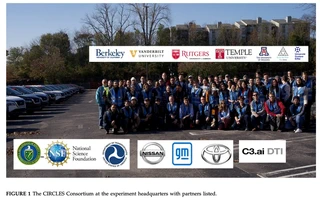 The CIRCLES project deployed 100 connected and automated vehicles on I-24 in Nashville, TN.
The CIRCLES project aims to reduce fuel consumption for all vehicles in the traffic stream via intelligent control of a small number of connected and automated vehicles. Unlike conventional cruise controllers and vehicular automation, the proposed work designs the control algorithm for the vehicle keeping in mind the impact that one vehicle can have on the overall smoothness of the traffic flow, and consequently the fuel consumption of all vehicles. The proposed work is also distinct from freeway control strategies that appear at fixed locations, such as ramp meters and variable speed limits, which are only able to actuate vehicles at fixed locations on the road network.
In November 2022, the CIRCLES team executed the largest coordinated driving experiment in history, deploying 100 vehicles with custom adaptive cruise control on I-24 in Nashville, TN. The experiment demonstrated that a small number of automated vehicles (approximately 5% of the traffic stream) can smooth stop-and-go traffic waves and reduce fuel consumption for all vehicles in the traffic stream.
This is collaborative research with:
- Alexandre Bayen (University of California, Berkeley, PI)
- Benedetto Piccoli (Rutgers University)
- Benjamin Seibold (Temple University)
- Jonathan Sprinkle (Vanderbilt University)
- Daniel B. Work (Vanderbilt University)
The period of performance for this project is January 2020 through December 2023.
This work is supported by the Department of Energy through the EERE Vehicle Technologies Office.
People


Related News
Friendship Fuels Innovation
Feb 26, 2025