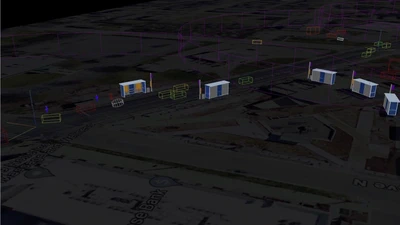
Leveraging Advanced Data to Deliver Multimodal Safety (LADDMS)
Expand Nashville’s LIDAR safety network and provide support for data analysis. In Partnership with NDOT, TSU, UT Chattanooga This project is part of a strong partnership with …

The major focus of the Compositional Systems Lab involves systems where a major portion of control, operation, or sensing, involves computing. Examples are cyber-physical systems, autonomous systems, and many kinds of robotics.
Technology to perform this research includes code generation, model-integrated computing, machine learning and data science, and AI. Theoretical understandings in systems theory, graph theory and rewriting, and models of computation is imperative to ensuring systems are built and run correctly.
The lab is led by Jonathan Sprinkle, Professor and Chair of Computer Science at Vanderbilt University.
Expand Nashville’s LIDAR safety network and provide support for data analysis. In Partnership with NDOT, TSU, UT Chattanooga This project is part of a strong partnership with …
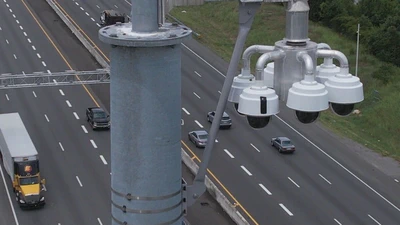
Develop travel time forecasting tools for arterial roadways based on crash detours and deploy them into the I-24 Smart Corridor. Source of Support: TDOT Total Budget: $600,000 …

Application of artificial intelligence to signal control of intersections. Source of Support: MWTCF Total Budget: $371,250 Performance Period: 2025/01 – 09/2026 Primary Place of …

This Cyber-Physical Systems (CPS) project will accelerate the design of controllers for large-scale engineering systems, focusing on the application of artificial intelligence in …

Collaborate with transit agencies in Tennessee cities on improved service through research-driven efforts. Source of Support: USDOT Total Budget: $8,666,053 Performance Period: …

Check out this story on the partnership between Jonathan Sprinkle and Dan Work, complete with embarrassing photos and links to previous research that lays the groundwork for what …

The CIRCLES Consortium was honored with the 2024 Institutional Lead Award at the IEEE Intelligent Transportation Systems Conference (ITSC). The project was recognized for …

The Council on Competitiveness featured the I-24 MOTION project and the CIRCLES experiment as a model for strategic public-private partnerships driving innovation. The article …

Fox News featured the CIRCLES project’s AI-powered cruise control system, reporting on how the technology can predict when a traffic jam ahead will clear and adjust vehicle speed …

Vanderbilt’s Government and Community Relations office highlighted the CIRCLES experiment, reporting that preliminary results showed a single AI-equipped vehicle could influence …
Rutgers-Camden Stories published a feature article on the CIRCLES Consortium’s partnership to conduct the world’s largest traffic experiment to test AI-equipped vehicles. The story …

TechXplore covered the CIRCLES Consortium’s landmark experiment on I-24 in Nashville, where 100 AI-equipped vehicles were tested in real traffic to combat phantom jams using …

Nashville’s WKRN News 2 reported on the CIRCLES experiment findings, covering how adaptive cruise control technology developed at Vanderbilt could ease phantom traffic jams on …

Vanderbilt News announced results from the CIRCLES experiment showing that AI-powered cruise control systems may pave the way to fuel efficiency and traffic relief. The five-day …

Popular Science featured the CIRCLES project’s approach to using AI-equipped vehicles that communicate to reduce traffic congestion, highlighting the I-24 experiment in Nashville …